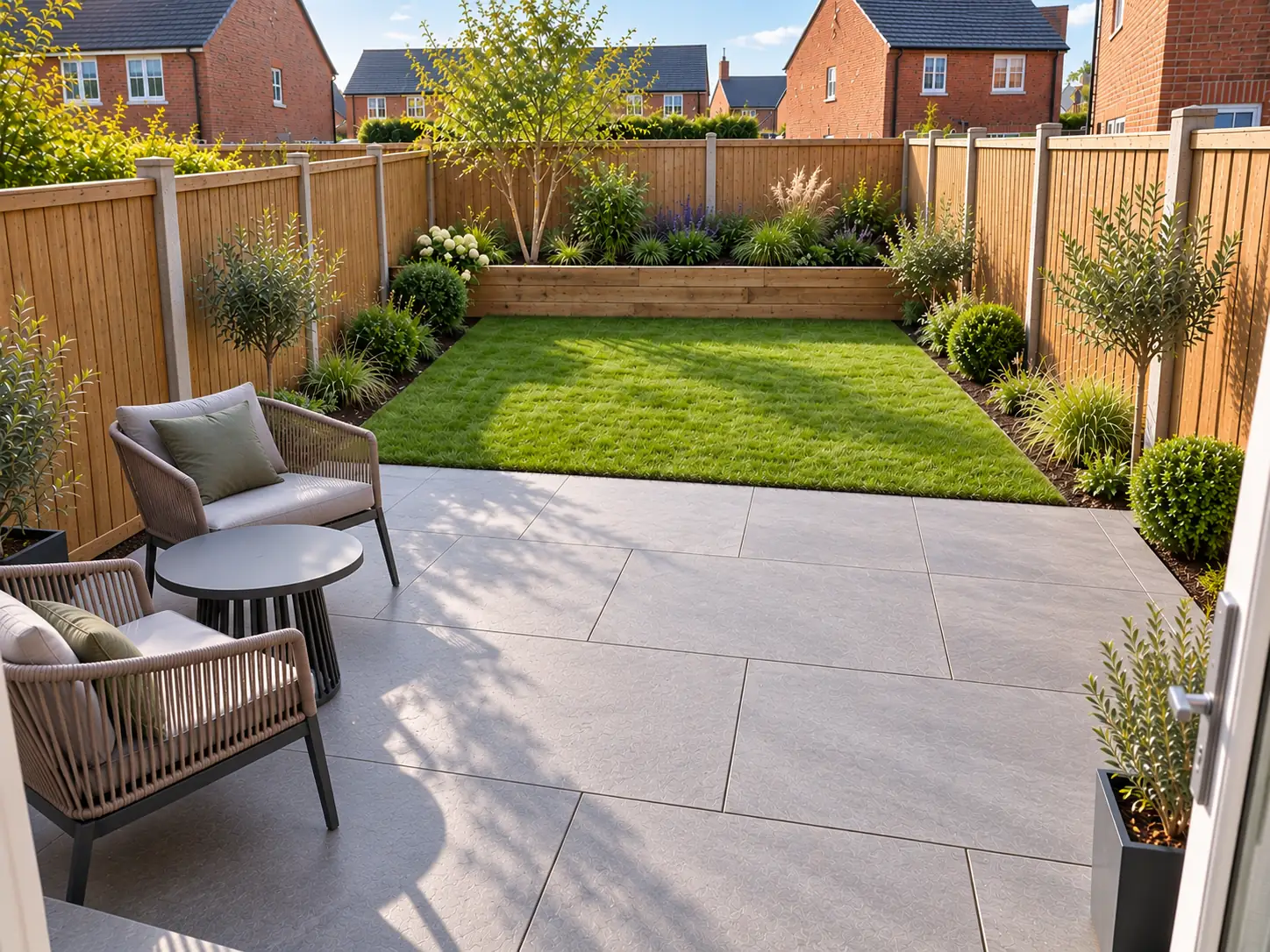
New-build gardens
New-build gardens in Peterborough: getting the patio right
What is often found under a new lawn on Hampton, Paston and other newer estates, how to plan for a small plot, and the planning wording for front gardens.
What’s often under a new-build lawn
A fresh lawn on a new estate can hide a fair amount. Turf is sometimes laid on a thin skim of topsoil over clay that heavy machinery has pressed hard, and bricks, concrete and offcuts left from the build are a common find once digging starts. Hampton is a good example: it was built from the late 1990s on former brick fields, where the Oxford Clay was dug for Fletton bricks. None of this rules a patio out. It simply changes what has to come out, and what has to go back in, so it belongs in the quote from the start.
Small gardens, careful choices
New-build gardens are often compact, so the patio may take up a large share of the plot. A paler slab makes a small space feel bigger, and a simple rectangular layout with fewer cuts usually keeps the cost down. Large-format porcelain in a small garden means fewer joints and a calmer look. Think about where the evening sun lands, too; many people end up wanting the seating area at the far end rather than by the back door.
Drains, manholes and air bricks
Check where the drainage runs before anything is planned. Inspection covers inside the patio area can be swapped for recessed trays and paved over neatly, so they stay accessible without spoiling the surface. Air bricks and the damp-proof course along the house wall must stay clear, which can limit how high the paving can sit by the back door.
Front gardens: what gov.uk says
If the front is on your list as well, the government’s guidance on the permeable surfacing of front gardens says:
“You will not need planning permission if a new or replacement driveway of any size uses permeable (or porous) surfacing”
“If the surface to be covered is more than 5 square metres planning permission will be needed for laying traditional, impermeable driveways that do not provide for the water to run to a permeable area.”
Guidance on the permeable surfacing of front gardens, gov.uk
Some estates also carry covenants or planning conditions about front gardens, so it is worth checking your deeds before changing anything at the front.
Raised patios on sloping plots
Where a back door sits well above the lawn, a raised patio can be tempting. The government’s technical guidance on householder permitted development says:
“A raised platform is any platform with a height greater than 0.3 metres”
Permitted development rights for householders: technical guidance, gov.uk
Raised platforms over that height fall outside permitted development, so check with Peterborough City Council’s planning team before anything higher is built.
Questions people ask
Can I pave a new-build front garden?
The gov.uk wording above sets out when planning permission is needed. Permeable materials, or letting rain run to a lawn or border, are the usual routes.
Is it worth waiting before building a patio?
Many owners wait through one winter after moving in. It shows where water collects and which spots get the sun.
What happens to rubble found during the dig?
It needs taking away, and the cost of doing so should be clear in the written quote.
Got a new-build garden to finish?
Share the postcode, rough measurements and a picture of the plot to request a free written quote. No obligation.